8 hours ago
Texas Attorney General Launches Tip Line to Enforce Bathroom Access Law Targeting Transgender People
READ TIME: 3 MIN.
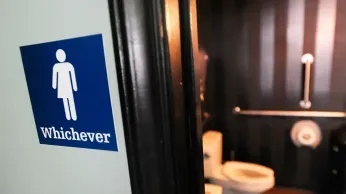
Texas Attorney General Ken Paxton announced the launch of a tip line on December 18, 2025, designed to facilitate public reports of violations under Senate Bill 8, the Texas Women’s Privacy Act. This law, effective since December 4, 2025, mandates that government buildings, schools, and colleges designate restrooms, locker rooms, and changing facilities based on sex assigned at birth, aiming to regulate access for transgender individuals. Institutions face fines of $25,000 for a first offense and $125,000 for subsequent violations per day, with individuals able to file civil suits if they claim to be affected by a breach.
The tip line, hosted by Paxton's office, requires submitters to first file complaints with the relevant agency and provide documentation before escalating to the state level. An option to upload photos accompanies the form, though photography inside restrooms remains illegal in Texas, as highlighted by a 2023 incident involving Williamson County GOP Chair Michelle Evans. Evans had her phone seized after posting a photo of a transgender woman in a Texas Capitol restroom, leading to an investigation by Travis County District Attorney Jose Garza; a federal appeals court ruled against her in early December 2025, upholding privacy concerns.
In a statement accompanying the launch, Paxton framed the tip line as a tool to "uproot and bring justice to any state agency or political subdivision that opens the door for men to violate women’s privacy, dignity, and safety," attributing the need for the law to "radical leftism" and risks posed by "mentally ill men." Supporters of Senate Bill 8, including conservative lawmakers, argue it safeguards women in vulnerable spaces by limiting transgender access to facilities aligned with their gender identity. However, the legislation provides no specific enforcement mechanisms, only requiring institutions to take "every reasonable step" to prevent violations—a vagueness critics say invites arbitrary application.
LGBTQ+ organizations and civil liberties groups have condemned the tip line as a mechanism to stigmatize and endanger transgender Texans. Brian Klosterboer, senior staff attorney for the American Civil Liberties Union of Texas, stated: "The 'tip line' wrongly encourages Texans to violate each other's privacy in bathrooms. The Attorney General has tried for years to vilify and dehumanize transgender Texans, but he can’t strip away every person’s right to privacy and right to live our lives free from gender stereotyping." The ACLU of Texas emphasized that such measures promote gender stereotyping and infringe on basic privacy rights for all individuals, including transgender people.
Advocates point to potential for misuse, noting that the law does not apply to private businesses, yet similar rhetoric has led to harassment incidents elsewhere. During legislative testimony on Senate Bill 8, proponents cited a case in Minnesota where a cisgender teenage girl was accused of being transgender by a restaurant server, harassed, and coerced into exposing her breasts to "prove" her gender; Minnesota lacks such restrictions, underscoring risks of vigilante enforcement fueled by anti-transgender sentiment.
Since Senate Bill 8 took effect on December 4, 2025, implementation has been inconsistent across Texas agencies. At the Texas Capitol on December 6, 2025, Department of Public Safety officers blocked a women’s restroom entrance and checked IDs of protesters attempting access, signaling strict adherence in some public spaces. Many colleges and agencies, however, have responded minimally with new signage and policy updates, asserting existing protocols suffice to comply with the "reasonable steps" requirement.
Paxton's office will investigate tip line submissions and recommend penalties only after agencies receive initial complaints, positioning the public as initial enforcers. This crowdsourced approach aligns with broader conservative efforts in Texas to regulate transgender rights, including prior investigations into gender-affirming care and school policies. Transgender rights groups warn that the tip line could exacerbate fears for transgender people navigating public spaces, potentially discouraging their participation in civic life.
The development occurs amid national debates on bathroom access laws, with Texas' measure focusing penalties on institutions rather than individuals directly. As reports begin flowing, observers anticipate legal challenges from groups like the ACLU, testing the law's constitutionality and scope. Transgender Texans and allies continue advocating for inclusive policies that affirm all gender identities without compromising safety.